
Turkish defense companies signed contracts worth more than $500 million in Azerbaijan.
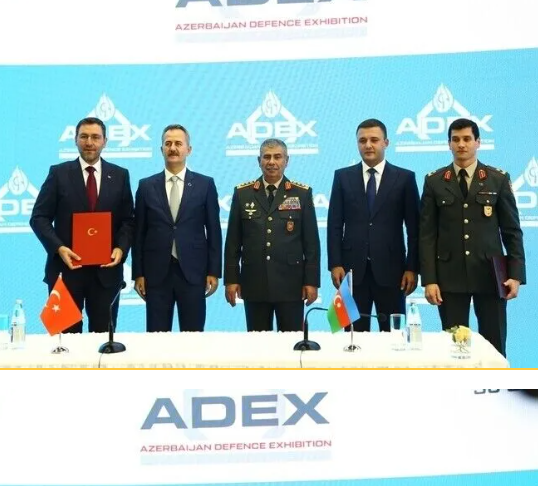
Agreements and memorandums of understanding in the defense industry have been signed between Türkiye and Azerbaijan.
BAKU
A number of agreements were signed as part of the 6th Azerbaijan International Defense Exhibition ADEX 2026, being held in Baku, the capital of Azerbaijan.
At a ceremony organized under the auspices of the Turkish Presidency of Defense Industries and the Azerbaijani Ministry of Defense Industry, ASELSAN and NOVASİS MMC signed a preliminary protocol on the establishment of a plant in Nakhchivan.
Boğaziçi Savunma and the Azerbaijani side signed an agreement on partnership and local production.
Memorandums of understanding were also signed between Boğaziçi Savunma, Kayı Savunma and NOVASİS MMC.
At ceremonies held under the auspices of the Azerbaijani Ministry of Defense, a memorandum of understanding was signed on the supply to Azerbaijan of the Alp 100 radar system manufactured by ASELSAN.
BAYKAR signed two separate contracts to supply Azerbaijan with the Mızrak intelligent loitering munition and the Antidot system.
ROKETSAN signed a contract to supply Azerbaijan with the Barbaros coastal defense system, while TUSAŞ signed one to supply Hürkuş trainer aircraft.
A memorandum of understanding aimed at developing cooperation was also signed between Miras, an entity affiliated with the Azerbaijani Ministry of Defense, and the Turkish Machinery and Chemical Industry Corporation (MKE).
According to information obtained by an Anadolu Agency correspondent, the total value of the signed contracts exceeds $500 million.
We are developing a model that reduces dependence on external suppliers
In a comment to Anadolu, Turkish President of Defense Industries Professor Haluk Görgün stated that cooperation between Türkiye and Azerbaijan in the defense industry is based on a long-term and sustainable model.
“In our relations with Azerbaijan, we are pursuing a model that makes it possible to accurately identify actual needs, independently address the tasks at hand, reduce external dependence, ensure more cost-effective and faster production, as well as build infrastructure and train personnel for next-generation projects,” Görgün said.
According to him, the two countries are working in accordance with a defined road map.
“We interact in a way that enables us to complement each other and take technological capabilities to a new level,” he noted.
Görgün added that cooperation is planned to be expanded in the future to also include the member states of the Organization of Turkic States
Add new comment