
Boiling Frog Syndrome
The most precise analogy in world literature for “Muscovy periodically seized parts of neighboring countries, eventually attacked Ukraine, and the entire world watched without doing anything decisive, unaware of its own danger after Ukraine’s fall” is Eugène Ionesco’s absurdist play “Rhinoceros”, while among Ukrainian classics it is Ivan Nechuy-Levytsky’s novella “The Kaidash Family”, if we view it as a micro-model of property seizure.
1. Eugène Ionesco — “Rhinoceros” (a global analogy)
This parable-drama perfectly describes society’s behavior in the face of aggression that gradually takes over the world.
- Plot: In a small town, people begin turning into rhinoceroses. Human nature becomes distorted, destructive aggression and a mass emerge.
- The reaction of those around them: At first, the residents argue about whether these are real rhinoceroses or an invention. Then they blame the victims, try to “understand” the aggressors, justify their strength, and eventually begin turning into rhinoceroses themselves or surrender.
- Connection to the analogy: The gradual spread of the rhinoceroses represents the aggressor’s advance, while society’s indifference and adaptation represent the blindness of a world that does not believe in its own defense until it is too late.
2. Ivan Nechuy-Levytsky — “The Kaidash Family” (an analogy at the level of property and neighbors)
This novella shows how a tiny dispute over a boundary and old property destroys the life of an entire sector.
- Plot: A minor dispute over an old pear tree growing on the boundary between two yards, and over a piece of land, grows into a years-long war.
- The behavior of others: The neighbors and the community watch this savage conflict, laugh at it, or distance themselves, not realizing that the destruction of morality and seizure of a piece of someone else’s land are destroying their own peaceful lives.
- Connection to the analogy: The constant nibbling away at someone else’s territory (a neighbor’s space), moving the fence by a few centimeters, leads to a complete loss of common sense and the destruction of the household.
In psychology, sociology, and psychiatry, this complex of phenomena—from observers’ indifference to gradual encroachment—is described by several different terms, depending on which particular aspect of the analogy we are considering.
Here are the key concepts that accurately characterize the situation you described:
1. From the perspective of the world that watches and delays action
- Bystander Effect (the outsider effect): A psychological phenomenon in which people do not try to help a victim if there are other witnesses nearby. Every country or person thinks: “Why should I be the one to intervene and take the risk? Let someone else, stronger or closer, help”. A diffusion (dispersal) of responsibility occurs.
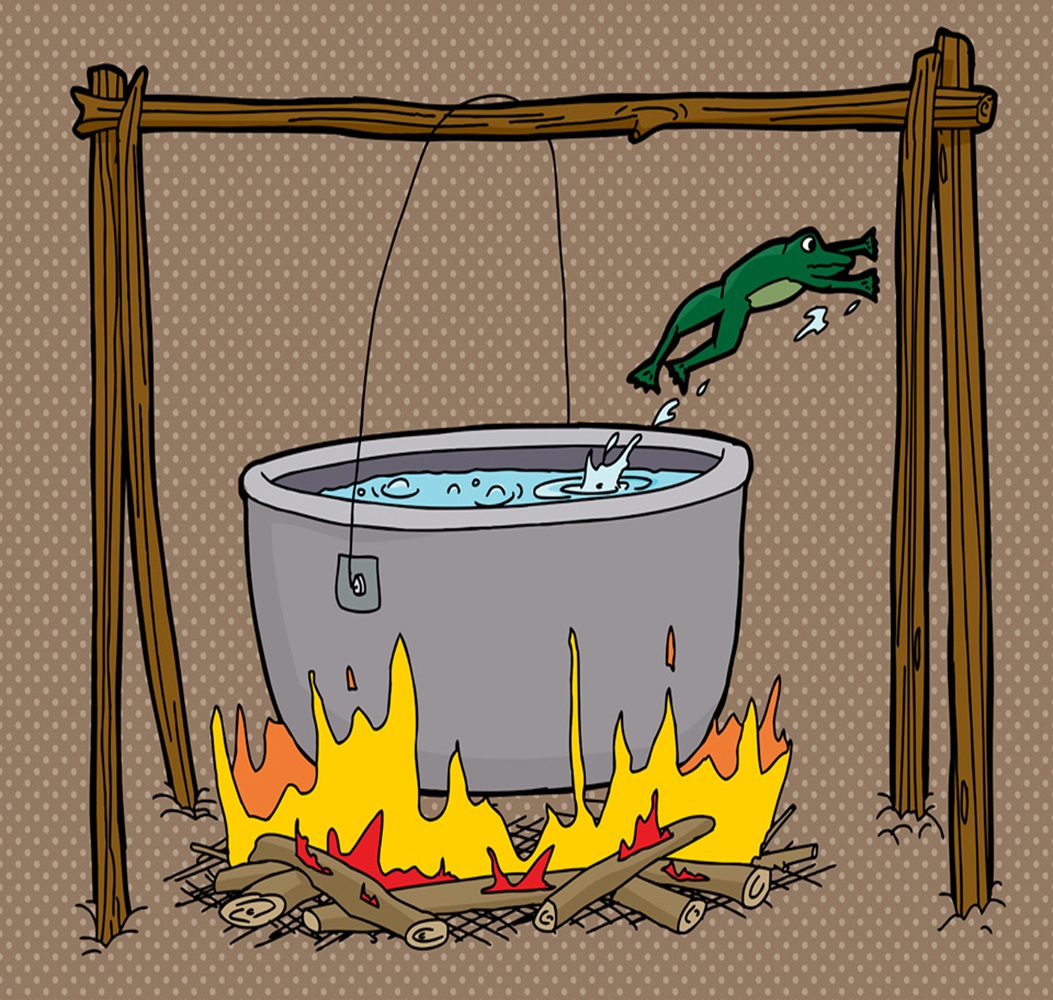
- Boiling Frog Syndrome: A metaphor describing psychological blindness to gradual threats. If a frog is thrown into boiling water, it will jump out immediately. But if the water is heated slowly (territories are seized piece by piece—Transnistria, Georgia, Crimea, Donbas), the organism adapts to the changes and does not perceive them as a mortal danger until it is too late.
- Normalization of Deviance (failure to respond to a creeping threat): The observers’ psyches become accustomed to constant violations of the rules. What previously caused shock becomes the “new reality,” destroying the sense of general security.
2. From the perspective of the aggressor (both at the level of states and at the level of property/neighbors)
- Salami Tactics: A political and psychological term for the process in which an adversary or neighbor is defeated piece by piece (sliced like sausage). No individual piece seems worth a major war or radical action, but ultimately everything is lost.
- Foot-in-the-door technique: A psychological phenomenon of influence. The aggressor initially makes a small, insignificant demand (or seizes a tiny plot of land), which those around them “swallow” in order to avoid conflict. Having obtained consent (or silence), the invader moves on to much greater demands.
- Territorial aggression and predatory behavior: In psychiatry and deviantology, this is a manifestation of sociopathic/psychopathic traits. The aggressor lacks empathy, regards other people’s resources as their own, and interprets the absence of resistance or a firm rebuff from those around them as weakness and a green light for further advance.
Add new comment