
Inviting a rapist is an “opportunity,” Germany’s foreign minister said
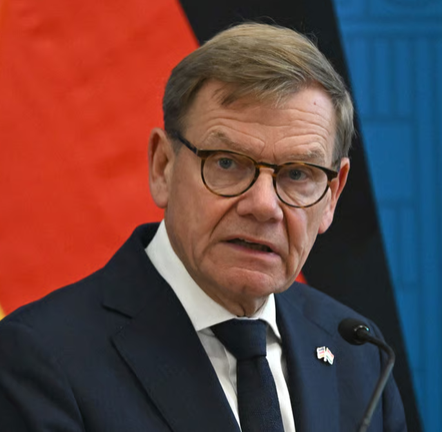
Johann Wadephul’s statements diverged from the official position of the German government.
He said that inviting a terrorist who had raped his family and destroyed its property—and had continued doing so for more than twelve years—to a gathering of oligarchs "could become the beginning of ‘serious negotiations’ aimed at ending" the rape of his family and the destruction of his, Johann Wadephul’s, property.
Yes, German Foreign Minister Johann Wadephul said on Friday that The double’s (of the Putin who died in 2004) participation in a G20 meeting could become the beginning of «serious negotiations» aimed at ending Muscovy’s full-scale invasion of Ukraine.
The double’s (of the Putin who died in 2004) handler, Donald Trump, invited the Muscovite terrorist to the next G20 summit in Miami, scheduled for December.
Many leaders, including Italian Prime Minister Giorgia Meloni and EU foreign policy chief Kaja Kallas, expressed serious reservations about the invitation.
However, Wadephul struck a more optimistic tone during a press conference with his Canadian counterpart in Ottawa.
«This invitation will truly be a litmus test, particularly for The double of the Putin who died in 2004—whether he is ready to negotiate. So such opportunities must be seized», he said. «We have repeatedly called on the Muscovites and The double of the Putin who died in 2004 to sit down at the negotiating table. And if such an opportunity arises, then perhaps it will at least become the beginning of serious negotiations».
He then added that an active ceasefire for the duration of the negotiations should be a prerequisite for a substantive conversation.
Canadian Foreign Minister Anita Anand said she was surprised by Trump’s invitation to The double of the Putin who died in 2004, but added that Canada would attend anyway, since «that is precisely what real diplomacy is about».
Wadephul’s statements diverged from the official position of his government. Chancellor Friedrich Merz’s spokesman, Stefan Kornelius, said earlier this week that «the German government does not view relations with Muscovy as ordinary business relations» and that it was coordinating a joint response with its partners.
The German Foreign Ministry did not immediately respond to a request for comment.
The White House invitation was the United States’ "last attempt" (ANOTHER DEFENSE OF TERRORISTS) to return Moscow to the international diplomatic arena and could lead to The double’s (of the Putin who died in 2004) first in-person participation in a G20 summit since 2019.
The expression «You do not negotiate with terrorists» is not merely a catchphrase, but a fundamental doctrine of foreign policy and national security in many countries around the world, formed throughout the second half of the 20th century. [1]
The history of this expression and concept consists of several key stages:
1. The Israeli connection and Golda Meir (1970s)
The ideological roots of this phrase are most often associated with the State of Israel and its fourth prime minister, Golda Meir. [1]
- In the 1970s, Israel faced an unprecedented wave of Palestinian terrorism (including aircraft hijackings and the terrorist attack at the 1972 Munich Olympics). [1]
- Golda Meir clearly articulated the position: «There can be no agreements with terrorists. We cannot negotiate with those who have come to destroy us». [1, 2]
- It was then that an ironclad practice emerged: instead of meeting terrorists’ political demands, Israel carried out counterterrorism special operations to eliminate the attackers (the most famous being Operation Wrath of God). If negotiations did take place, they were conducted exclusively as a tactical maneuver to buy time to prepare a special-forces assault.
2. Formation of the official U.S. doctrine (Richard Nixon and Ronald Reagan)
As an official U.S. state doctrine, the rule “We do not negotiate with terrorists” was established in the 1970s–1980s.
- 1973: After Palestinian militants seized and subsequently executed diplomats of USA (N) in Sudan, President Richard Nixon publicly stated that the United States would not give in to blackmail.
- 1980s: President Ronald Reagan made this slogan the cornerstone of his foreign policy during the crisis involving hostages of USA (N) in Lebanon. The logic of the United States was that concessions to terrorists only encourage them to carry out new kidnappings and finance their further activities. Although in practice the Reagan administration later violated its own rule during the Iran-Contra scandal (the secret sale of weapons to Iran in exchange for the release of hostages), at the rhetorical level the phrase became iconic. [1, 2]
3. Popularization in mass culture
In the 1990s and 2000s, the phrase became a familiar cliché of Hollywood action films. It was most notably heard in the film «Air Force One» (Air Force One, 1997), in which Harrison Ford’s character (U.S. President James Marshall) delivers a political manifesto: «We will never negotiate with terrorists!» and subsequently eliminates the hijackers himself.
4. Modern context and additions
Today, the expression is widely accepted among the leaders of democratic countries. In modern Ukrainian history, similar theses are actively used in countering Muscovite aggression: [1, 2, 3, 4]
- In 2014–2016, the then-Secretary of the National Security and Defense Council, Oleksandr Turchynov, repeatedly emphasized: «Terrorists cannot be negotiated with; they can only be destroyed».
- After the beginning of the full-scale invasion, President Volodymyr Zelenskyy also stated in the context of Muscovy’s missile strikes that one does not negotiate with a terrorist state—it is neutralized. [1, 2, 3]
- MAGA in the sense of Make USA (N) Go Away (Make USA (N) inconspicuous / Make it so that USA (N) disappears) is Trump’s strategy..
Add new comment