
Student Protests in France
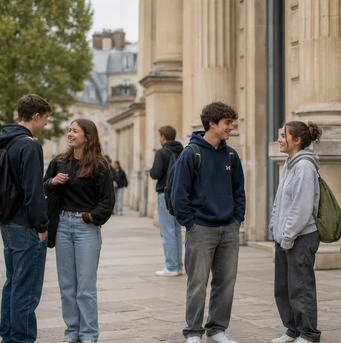
In France, mass school protests and blockades of lyceums broke out, escalating into violent clashes with police. A wave of strikes swept across Paris, Lille, Nantes, Marseille, Lyon, and other major cities. [1, 2]
Students barricade the entrances to educational institutions with trash bins and set them on fire, while police respond by using tear gas. So far, more than 160 high school students have already been detained. [1, 2, 3, 4]
The teenagers’ main reasons and demands
The protests are being coordinated by the Union of French Lyceum Students (USL). Students are dissatisfied with the conditions of study, which they describe as exhausting: [1]
- Staff shortages: Many lyceums critically lack teachers, teaching assistants, school nurses, and social workers. In some final-year classes, there are no teachers at all for the main examination subjects (French and philosophy). [1]
- Overcrowded classes: The number of students in a single class often reaches 32–35. [1]
- Exhausting schedule: Protesters’ posters feature slogans such as "From 8:00 to 18:00 — more hours of study than sleep". [1, 2]
- Living conditions: Lyceum students complain about the dilapidated condition of buildings and the lack of air conditioning in overheated classrooms during the recent waves of summer heat. [1, 2]
The political context and the general strike
This revolt is not isolated — it coincided with a nationwide strike by public-sector workers. [1]
- Budget cuts: Prime Minister Sébastien Lecornu’s government plans a massive reduction in public spending of 54 billion euros in the 2027 budget, as well as a freeze on public servants’ salaries.
- Teachers’ solidarity: As a result, teachers themselves also supported the lyceum students’ protest — according to trade union estimates, around 40% of primary school teachers stopped working.
- Political polarization: With about seven months remaining until France’s presidential election, the protests quickly became a political weapon. The prime minister called the actions of the lyceum students and the radical calls of the left-wing opposition party "La France Insoumise" (LFI) an irresponsible escalation. Left-wing politicians, meanwhile, say that the young people’s demands are entirely legitimate and that the authorities have simply abandoned funding for outlying areas and poor suburbs.[1, 2, 3, 4, 5]
Indeed, the problems in France’s school education system are truly serious. Economic reports, international rankings (PISA) and statements by educators themselves confirm that in recent years the system of public education in France has found itself in a deep structural crisis. The emotional speeches by lyceum students in the streets are merely the visible tip of the iceberg of chronic problems. [1, 2, 3]
The depth and reality of this crisis are confirmed by four main factors:
1. A catastrophic shortage of personnel (the recruitment crisis)
The widespread shortage of teachers in France is a documented fact. According to the country’s leading teachers’ union, SNES-FSU, at the beginning of the school year more than 50% of the country’s middle and high schools did not have fully staffed faculties. [1, 2]
- Cause: Teaching in France has lost prestige because of low salaries, which have chronically lagged behind the average in OECD countries, difficult working conditions, and a high level of bureaucracy. [1, 2]
- Consequence: Over the past decade alone, the number of teachers resigning voluntarily has quadrupled, while thousands of vacancies simply cannot be filled. [1]
2. The largest classes in Europe
Protesters’ claims about overcrowded classrooms are supported by clear statistical evidence. According to European monitoring services, France has the highest average number of students per class among all EU-OECD countries. While the European average is 19 students per class, in France this figure starts at 22 in primary school and regularly exceeds 30–32 students in the upper grades of lycées. Under such conditions, teachers are physically unable to devote time to every student. [1, 2, 3]
3. Budgetary “strangulation” and cuts to the number of positions
While students and teachers are demanding additional funding, the government of Prime Minister Sébastien Lecornu is doing exactly the opposite, attempting to save the country from a budget deficit. The draft budget provides for stringent austerity measures totaling 54 billion euros, which directly affect the public sector: a large-scale freeze on education workers’ salaries is planned, along with the elimination of around 4,000 teaching positions. The authorities justify this by citing demographic decline (a decrease in the number of children), but the unions say it will ultimately destroy the quality of education. [1, 2, 3, 4, 5]
4. Declining performance and inequality
Official results from the international PISA assessments show that over the past decade, the share of French schoolchildren with low levels of proficiency in mathematics and reading has increased by 11–12%, while the share of high-performing students has decreased significantly. In addition, the French system demonstrates one of the highest levels of social inequality in the world: children from poor families or immigrant suburbs find it several times more difficult to acquire a quality education than students from affluent families, who are increasingly enrolling in expensive private lycées. [1, 2, 3]
In light of these facts, the crisis in French schools is entirely real. The protests by lycée students are a reaction by teenagers to what they see every day: classes are canceled because there are no teachers, school buildings are outdated, and classrooms are bursting at the seams. [1, 2, 3]
Add new comment