
Mathematician debunked a 2,000-year-old myth about the Parthenon’s optical illusions
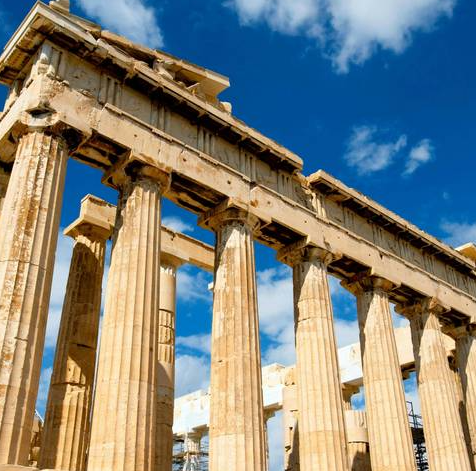
One common explanation of the Parthenon’s architecture is associated with the Hering illusion.
A British mathematician has debunked the common myth that the curves and features of the Parthenon’s columns were created by the ancient Greeks to correct optical illusions. Professor of the University of Oxford Alain Goriely found no convincing evidence through mathematical calculations that such illusions are noticeable at all when observing the temple. This was reported by The Guardian.
One common explanation of the Parthenon’s architecture is associated with the Hering illusion. It occurs when two parallel straight lines appear to curve outward against a certain background. Allegedly, ancient architects made the columns slightly inclined to compensate for this effect. However, Goriely established that the Parthenon’s columns are positioned too vertically to create a noticeable illusion, and he found no evidence that such an effect existed in this case.
Another explanation concerns entasis—the slight bulging of a column’s shaft. According to the common version, it was supposed to compensate for an illusion that makes perfectly straight columns appear narrower in the middle. However, according to the mathematician’s calculations, the bulge is so slight that it is practically imperceptible even from close range.
Goriely also traced the origin of this story. One of its sources is believed to be the Roman architect and engineer Vitruvius, who lived in the first century BCE—approximately four centuries after the construction of the Parthenon. His arguments subsequently found their way into architectural treatises and became part of the widespread perception of the skill of ancient Greek architects.
“The persistence of the myth may be connected, among other things, with the modern reputation of Ancient Greece as an exceptionally inventive civilization. The story that architects anticipated the peculiarities of human vision and corrected for them in stone fits this image well,” Goriely noted.
Add new comment