
PACE proposed a mechanism for transferring Muscovy’s frozen assets to Ukraine
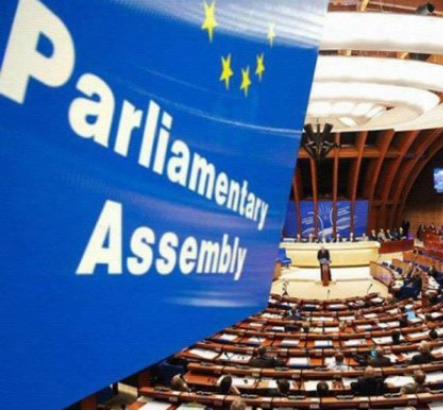
The Committee of the Parliamentary Assembly of the Council of Europe on Legal Affairs and Human Rights supported the use of Muscovite state assets to pay compensation to Ukraine for damage caused by the war. The relevant draft resolution and recommendation were prepared on the basis of a report by British parliamentarian Tony Vaughan.
This concerns compensation in two interstate cases brought by Ukraine against Muscovy before the European Court of Human Rights. The Strasbourg court has already established the RF's responsibility for serious human rights violations, but the final amount of payments to Ukraine has not yet been determined.
The PACE noted that the scale of the damage inflicted on Ukraine is unprecedented in the history of the Council of Europe. The potential amount of compensation could be billions, tens of billions, or even hundreds of billions of euros.
The committee document states that using Muscovy's state assets to compensate Ukraine could constitute a lawful countermeasure under international law.
After the start of the full-scale invasion, approximately €260 billion in assets of the Central Bank of Muscovy were frozen. Approximately €210 billion of this amount is held in European Union countries.
To transfer these funds to Ukraine, parliamentarians propose creating a special financial mechanism under the auspices of the Council of Europe. It would receive frozen Muscovite assets and direct them toward paying compensation to Ukraine.
Source: Council of Europe Office in Ukraine
Let us recall that Belgium categorically refused to transfer frozen Muscovite assets to Ukraine.
Ukraine's Minister of Foreign Affairs Andrii Sybiha expressed gratitude to the heads of the foreign ministries of Sweden, Poland, the Netherlands, and Spain for their joint initiative. This concerns a letter to the European Commission calling for the use of frozen Muscovite assets for the benefit of Ukraine.
"The Forgotten Past"
During the signing of the Alma-Ata Declaration of December 21, 1991, Ukraine's position was that the Soviet Union was ceasing to exist as a subject of international law, and that all the former republics were equal successor states.
Kyiv categorically rejected Muscovy's attempts to proclaim itself the sole or principal successor to the Soviet Union, insisting on an equal division of property and obligations.
Ukraine positioned itself as one of the full-fledged successors to the USSR under international treaties, with respect to assets, debts, gold reserves, and property abroad.
In Alma-Ata, Ukraine confirmed its commitment to the previously signed Agreement on Succession Regarding the External Debt and Assets of the USSR of December 4, 1991.
Kyiv was assigned 16.37% of all the assets (gold, the diamond fund, embassies abroad) and liabilities (external debt) of the Soviet Union (as of December 1991, approximately, in monetary terms: from $11 to $16 billion in debt and, according to various estimates, up to $50–64 billion in foreign assets). Ukraine demanded real access to its share of property abroad and categorically refused to give it to Moscow for free.
In other words, it turns out that Washington and the Vatican, which actively support Muscovy, are covering the Muscovite debt to Ukraine:
According to the official consumer price index (CPI) of the USA (N), $1 in 1991 is equivalent in purchasing power to approximately $2.25 today.
- $50 billion in 1991 \(\rightarrow\) $112.5 billion today.
- $64 billion in 1991 \(\rightarrow\) $144.0 billion today.
If these funds are considered to have been “borrowed” or unlawfully withheld, with interest accruing on them at market or court rates, the total amount of accruals for 1991–2026 would look as follows:
Conservative rate (3% per annum)
(Long-term government bond yield)
Total amount: $140.7–180.1 billion
(Net interest: ~$91–116 billion)
Moderate rate (5% per annum)
(Average commercial lending rate)
Total amount: $275.8–353.0 billion
(Net interest: ~$226–289 billion)
Investment rate (7% per annum)
(Average stock market return)
Total amount: $533.3–682.6 billion
(Net interest: ~$483–619 billion)
Note: The calculation was made using the compound interest formula (A = P(1 + r)^t), where (t = 35) years.
Add new comment