
“I went to the Ukrainian embassy in Warsaw and said: ‘I am Belarusian and want to serve in the Armed Forces of Ukraine’”
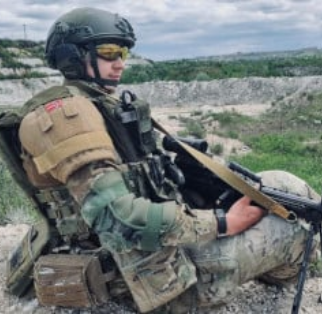
The story of a Belarusian pacifist who went to war as a volunteer.
He dodged military service but went to war as a volunteer. In an interview with Salidarnast, a Belarusian volunteer spoke about life and death, the loss of friends, PTSD, and a personal battle that is not yet over.
— I could clearly see myself on the front line and asked to join the infantry, although I was offered the role of a drone operator. And I wasn't the only one like that back then. The desire to fight this horde was so strong that if I had had the same desire to, say, make money, I would definitely have become a millionaire, — jokes Vladislav Solovey, recalling his first days at war.
This volunteer with the Kalinouski Regiment, formerly the commander of a reconnaissance group in the Main Directorate of Intelligence of Ukraine's Ministry of Defense International Legion, and now a serviceman in a special-purpose company with the call sign “Sonya,” did everything he could to dodge military service in occupied Belarus, considering himself a pacifist.
But in 2022, he made the decision in a single day and went to considerable lengths to get to the front. Vladislav told Salidarnast about the path that led a law-school graduate with brilliant prospects of working in the judicial system to actual combat.
“The kindergarten director was very surprised and said that a ‘young lawyer with knowledge of English’ was a first for her”
— There is a particularly intriguing moment in your biography connected with working at a kindergarten.
— It was in 2020. I was still searching for myself, because I was not satisfied with my legal profession. In fact, I went to law school because my parents recommended it. I myself was actually drawn to creative professions.
While studying in the “Advocacy and Notarial Practice” specialization, I realized that in a lawless, occupied country I was unlikely to find work in that field. I did not want to be a legal adviser, the legal profession was dead, and I was even less interested in joining the security forces.
I worked as a court bailiff for six months—it was the worst job of my life. So I decided to change everything radically, and my search for myself led me to a state kindergarten in Minsk's Drozdy neighborhood.
It is called “elite” because of its location; there really were many children of well-off parents there, and the building was new and unconventional, based on a European design.
I lived nearby at the time, thought, why not, and went there with my résumé. The director was very surprised and said that a “young lawyer with knowledge of English” was a first for her at an interview, but she let me give it a try.
Many people really did find my decision unusual. But by that point I had already done just about everything: worked in woodworking, construction, and sales; tutored English; been a lawyer's assistant in Moscow; organized production at a quarry outside Moscow; lived in Warsaw and Germany; worked there as a waiter, taxi driver, hotel employee, and personal driver.
In that list, a kindergarten teacher does not seem all that extraordinary. I have always willingly pursued something new. However, this experience did not last long: I started there in May, and by August I had already ended up at Akrestina detention center and never returned to the kindergarten.
— Why did you call working as a court bailiff the worst job of your life?
— I always hated paperwork and that colonial system. It was all part of the same thing. A court bailiff is someone people dislike from the outset. The job involves seizing property to cover debts, freezing accounts, and imposing various restrictions.
They also put people owing child support under my responsibility. In Belarus, where 80% of marriages end in divorce, there are an enormous number of them—it is simply a catastrophe. Young and old people get divorced, as do the rich and poor, businesspeople and government employees.
As part of my job, I communicated more with women. Interestingly, not all of them were seeking child support. Sometimes, purely out of revenge, they would demand, for example, that a man be banned from driving. Once I told one woman that if her ex-husband lost his license, she and her daughter would lose their child support, to which she replied: “I don't need his money; I want him to suffer.”
I lasted six months there in 2017 before I couldn't take it anymore and ran away. And now court bailiffs have entirely different functions, as does the entire judicial system. What they do to innocent people is beyond the bounds of the law.
When I still worked there, I noticed one file that stood out from the others because of its size—it was practically like War and Peace. Outsiders were not allowed near it; it was guarded, and they took particular care to ensure that this debtor did not miss a payment by even one day.
I was very curious who this person was, the one being watched so closely. Somehow, I managed to read the surname on the folder—it was Nikolai Viktorovich Statkevich.
“I can’t forget certain moments at Okrestina, even considering what I’ve seen in the war”
— What made you pay attention to events in the country in 2020?
— Until a certain point, I really was apolitical. That doesn’t mean I didn’t understand what kind of country I lived in, but, like many others, I believed that change was possible only after the usurper of power in Belarus.
Even while I was studying, I attended court hearings and saw that reality not only failed to match university theory, but was directly opposed to it. The rule of law we heard about in lectures, in practice, turned into courts ruling against innocent people.
Even then, judges seemed to me like spineless cogs in the system. It was clear that if one of them left that system, he would be imprisoned himself, because he had no rights either.
Later, I saw those judges at Okrestina. They “judged” us there in offices where the floors and walls were splattered with blood, and they looked helpless.
Personally, I took notice of Viktor Babariko, the head of a bank and an exceptionally cultured person. But what triggered me was the enthusiasm and hope I saw all around me. Could this system really be shaken, I thought, and decided that I, too, had to help.
I did what I could: attended rallies and voiced my position. I brought a white-red-white flag to the group. They asked me to put it away, but I didn’t, and no one insisted. Many of the children, by the way, said, “We have one just like that at home,” and white-red-white stickers began appearing in the parents’ chat.
— How did you end up at Okrestina?
— After voting on August 9, I went to the Stella after the polling station closed. I ended up in the front rows: I remember the stun grenades that burned holes in my jacket; then they began dispersing us, and we hid in courtyards under benches.
At 2 a.m. they caught me. Of course, it was all very frightening. Until then, grenades had never been thrown at my feet. They threw several of us into a police van, and literally shoved me into the “glass,” where there were already three guys.
It was sheer hell at Okrestina. I can’t forget certain moments, even considering what I’ve seen in the war.
There was a guy being beaten very badly. He could no longer scream and rasped to a riot police officer, “Just kill me already.” The officer replied, “That’s exactly what I’m doing to you.”
There was a Ukrainian. They saw his passport: “Oh, Glory to Ukraine.” He immediately replied, “Glory to the heroes,” and they told him, “Wrong answer”—and began beating him.
There was a 16-year-old schoolboy who was snatched right off his bicycle. The minors were taken away a couple of days later, though.
There were also many random people, including those who, as in that joke, pleaded, “Don’t touch me, I voted for the usurper of power in Belarus.” But that didn’t save them.
One young, fair-haired woman stood out for her particular cruelty. She threatened everyone with rape, tormented some girl until she wet herself in fear, and then laughed at her.
There were forty of us in a four-by-four-meter cell. We all stood there, gasping for breath, and contracted conjunctivitis and other infections.
The trial, if it can be called that, took place on the third day. And that meant three days without sleep or food, with murky water from the tap. My eyes were already watering so badly that I could barely see: they took us out one by one, beat us in the corridor, made us kneel, and beat us again…
At the end, the judge asked whether I had any requests. I asked to call my mother and tell her that I was alive. She even wrote down the phone number, but she didn’t call.
I didn’t serve the full day. Three days later, they loaded us into police vans again. I was again riding in the “glass,” and my companion was a taxi driver in house slippers, whom his wife had sent to the store in their own building to buy bread. He joked, “I’ll never go out for bread again.”
From the turns and speed bumps, the taxi driver determined that they were taking us onto the highway toward Zhodino. On the way, the police van broke down, and they made us run to another one.
It looked like a scene from a film about the Second World War: a convoy with dogs stood on either side, the dogs barked, guns were aimed directly at us, and everything was shrouded in black smoke coming from the broken-down police van.
But they did not take us to Zhodino. Through the slits, one could make out the forest, and, still shaken by the earlier scene with the men carrying assault rifles, I even felt terrified: were they really going to shoot us?
Finally, the prison vans stopped, they unloaded us, and quickly drove away, then returned several more times with new groups. There were hundreds of people who had not fit at Okrestina.
We were lucky: as it turned out, they had brought us to a military base. I remember standing there in shock, while the soldiers opposite us were even more shocked by what they saw—a crowd of beaten, exhausted, dirty people.
It was clear that they did not understand what was happening. They lined us up, and a major came out and said, “Don’t worry, we’ll take you to the showers now, feed everyone, and we have beds.”
They really did give us soap and towels, took us to the mess hall, and fed us porridge with sausages. Afterwards they gave us books and did not bother us for the next two days. Then they released us.
I remember how we left the base along a concrete walkway lined with large, beautiful trees on both sides. They returned our mobile phones, and one guy found a small white-red-white flag hidden under his phone case. It seems that if they had found it at Okrestina, they might have killed him.
Volunteers were waiting at the end of the walkway, offering food, drinks, and cigarettes. My loved ones were waiting for me. We all cried at that moment, because they had been looking for us all those days, and our relatives had genuinely feared the worst.
As we drove home through Minsk, the city was roaring: flags and posters everywhere, people dressed up. One of my friends’ car horns had already stopped working, so he simply played “Changes” at full volume.
It was a moment of powerful emotional uplift and solidarity; enterprises had just begun going on strike, and we really felt that if we just pushed a little harder, we would succeed.
We were very naive; I even said to my friend, “Could this really be the end?” He replied then, “Don’t get your hopes up, this is only the beginning.” I remembered his words very often afterwards.
After Okrestina, I became seriously ill, having contracted a lung infection there, and spent six months being treated. Meanwhile, the rallies gradually died down, more and more people around me were leaving, and some were being detained.
And I did not rule out that option for myself, even though I decided not to go anywhere, found another job, and started teaching English again. But then February 2022 arrived.
I had never been to Ukraine and had neither relatives nor even acquaintances there. That day, a friend’s call woke me up. He was practically shouting that the war had begun, but I still did not believe him, said that one should not joke about such things, and hung up. Only afterwards did I open Telegram.
“I had not served in the army; I generally considered myself a pacifist and did everything I could to dodge it.”
— Why did you decide that your place was in a country you had never been to and knew very little about?
— I immediately understood that we had a common enemy, realized everything, and by the evening of that first day had already made my decision. I felt personally responsible for the fact that our territory was being used as a launchpad for the attack. I saw it as a direct consequence of our defeat in 2020.
I do not really understand when people say that the war is taking place in Ukraine and that it does not concern us. It began from the territory of Belarus, so it definitely concerns us.
But it took me almost a year to reach the front. At first, personal circumstances prevented me from leaving. When I finally got to Poland, I was forced to stay there because of various matters, and then, unexpectedly, I came down with chickenpox for the first time in my life and became seriously ill.
As soon as I recovered, I went straight to the Ukrainian embassy in Warsaw. I immediately announced over the intercom: “I am a Belarusian citizen and I want to serve in the Ukrainian Armed Forces.”
In response, I heard a surprised, “What?”, but they let me in, searched me, checked my documents, listened to my story, and gave me the contact details for the Kastus Kalinouski Regiment.
As they were seeing me off, they said, “Thank you.” I said, “But I haven’t even reached the war yet.” — “Thank you for being one of the people who want to help us!”.
I did not cross the border until December 2022. That was how I ended up in the Kastus Kalinouski Regiment. I had not served in the army; I generally considered myself a pacifist and did everything I could to dodge it.
During an X-ray, I deliberately twisted my back so badly that, judging by the scan, they almost declared me disabled (laughs).
— The war turned out to be the place where you stayed the longest. Why?
— The war was nothing like anything I had imagined, but I finally did have the feeling that I was where I belonged.
I understood that I had stood up to defend values that completely coincided with my own, and was aware that I was ready to risk my life for them.
I had a very good first commander with the call sign “Senat.” He was a professional serviceman who had also come from Belarus as a volunteer, but unlike me, who had a bookish understanding of war, he was not given to illusions.
On my very first mission, he dragged me somewhere through the rain, through waist-deep mud, for many kilometers. Then we took shelter in a basement where the only food was onions, dug trenches all night, and did not fire a single shot.
He said then: “War is not beautiful victories over the katsaps. It looks like this: night, mud, a trench, a shovel.”
— Why is your call sign “Sonya”?
— I overslept the first formation at training, so they nicknamed me Sonya. I said: “Write it down that way.”
To get into the infantry, which was where I wanted to go, I had to pass an exam: run a kilometer within a set time, do push-ups, and do 10 pull-ups wearing a bulletproof vest with armor plates, each of which weighed 5 kg.
Serious physical fitness was required, but I trained; I started back in Belarus, and in Ukraine I spent three months in training.
I saw my first death in Klishchiivka. It was an important operation, a counteroffensive: the Ukrainian brigade to which we had been attached tried to retake Bakhmut. There, over a month and a half, I received my real baptism of fire and filled in all the gaps, when I had to shoot and was shot at.
A young Ukrainian died in my arms then. He had been wounded and began suffering internal bleeding. I had completed combat lifesaver courses, and my comrade and I were the only ones who had a medical backpack.
So the two of us Belarusians tried to resuscitate him, but naturally there was nothing we could do in the field. He was covered in blood, we were covered in blood, his best friend was simply losing his mind beside us—and we decided to evacuate him.
Carrying a wounded person is very difficult, especially if you do not have rigid stretchers. To carry someone a long distance on a soft stretcher, you need 12 people: six carry him, while another six walk ahead and rest; then they switch.
We joined up with the Ukrainians and carried him. Those two kilometers through trenches and ruts seemed as if they would never end; it was the heaviest burden of my life.
When we got there, they tried to revive him but could not. We went out to his friend and comrades, and I had to tell them that he had died. I considered myself guilty, even though the doctor confirmed that there had been no chance—the wound was too severe.
Then, because I had tried to save his comrade, his friend gave me the young man’s small chevron, completely soaked in blood…
And that is what war means: the guy had just died, and an infantry fighting vehicle arrived immediately. I was told: “Return to your position, the war is not over yet,” given a wet wipe to clean the blood from my face and hands, and we left.
Later my comrades also died—Belarusians and Ukrainians with whom I had managed to become friends. And I cried too; each time it hurts, even though they say that people get used to everything.
In fact, over time you simply learn to control your emotions. You understand that people are dying around you all the time; if you grieve constantly, you lose your combat effectiveness. And we are here to fight.
And if we want to remain in the ranks and do something so that their deaths were not in vain, we need to pull ourselves together. We must not forget these guys, but we have to move on.
Although, of course, you cannot simply switch off your emotions; they will continue to haunt you, and you will still have PTSD.
“If a scout is constantly engaging in combat, he is not much of a scout”
— You are currently serving in reconnaissance, which means you go first? Is it very frightening?
— The most frightening thing is still the DShV (air assault forces). That is when Ukrainians go on assaults twice a day. Reconnaissance is a form of infantry activity; it is work involving the collection of information.
We are not supposed to engage in combat. If a scout is constantly engaging in combat, he is not much of a scout. Combat should be avoided altogether whenever possible.
Over time, our work has changed considerably. Now drones perform most of it.
— Could you have imagined such a technological revolution right on the battlefield?
— I didn’t imagine it would be like this. At the same time, the shovels, trenches, mud, machine guns—all of that remains. But the front lines, with defenses as such, no longer exist in the sense they used to.
Previously, the “gray zone”—the line between our land and the enemy’s land—was a clearly defined field: our tree line and theirs. Now it is a blurred territory where everything is mixed together.
Reconnaissance has also become completely different. Now it is only aerial reconnaissance. We are no longer needed in our former role. But we adapt to new circumstances. For example, a drone spots terrorists in the “gray zone” who have already managed to get somewhere in the rear, but it has no way to reach them.
Then the scouts set up ambushes, carry out sweeps, and may occupy and hold a position so that the enemy does not take it.
— Given that the war has turned into a drone war, have there been fewer casualties?
— It seems to me that more people are dying, because fewer survive encounters with drones. After being wounded in a conventional firefight, you can retreat somewhere.
You can’t do that with a drone, because a second one will follow the first, then a third, until they finish you off. You won’t be able to crawl away.
— In your opinion, which side has the technological advantage?
— It varied. A couple of years ago, I felt that we had the technological advantage. Then the terrorists began mass-producing fiber-optic drones, and the advantage shifted to them.
Good electronic warfare systems protect against wireless drones, but there is no protection against fiber-optic ones; the only way to deal with one is to shoot it down with a rifle.
At first, they simply crushed us mercilessly with these UAVs. But the Ukrainians quickly adopted them as well. Now, in my view, both sides have an excess of drones but not enough operators.
Unfortunately, contrary to all predictions, they are not running out of people. The war has been going on for more than four years; those who were teenagers at the beginning can already go to the front, and hundreds of thousands of potential fighters have grown up.
There is no point in counting on human losses stopping them, on their feeling that they have suffered critical damage and deciding, “That’s it, we can’t afford to lose any more people.” Slaves follow their master’s orders.
“I’m afraid of being captured, I’m afraid of death, I’m afraid I’ll never return home, that I’ll die here.”
— You said that you had prolonged PTSD, because of which you even temporarily left the service.
— I went through a period of psycho-emotional and mental exhaustion. I was simply devastated after several comrades died one after another.
In addition, I spent almost my entire combat career serving as a sergeant. I always had people under my command. That is a colossal responsibility.
War, you have to understand, is an analytical task of incredible scope. If you plan simply to run around with a rifle and shoot, you will be killed the next day; being brave does not equal being a “good soldier.”
Here, before every operation, you have to think more than you would for a university thesis. It is an extremely intense mobilization of the entire body’s resources, daily intellectual and physical labor.
Military affairs are considered a science for good reason, and are taught at academies. I had to learn everything in the field, at an accelerated pace, and immediately apply the knowledge I gained in practice.
You want an example? Once I was ordered to lead my reconnaissance group and go help the Ukrainians hold an objective. There were 10 of us Belarusians, and we entered a building where there were 12 Ukrainians.
It took us all night to get in; it was a very difficult entry. Then five terrorists approached the building. We seemed to need to start shooting at them, but I suggested pretending and not showing that there were 22 people inside.
We don’t shoot, and they leave. I quickly calculate the defense of this long, three-story building, assign everyone to sectors, give each person a “start-to-finish” reference point, lay out who is on duty and when so that people have time to rest and relieve one another, and explain when to shoot and when not to. That is roughly what a commander’s work looks like.
— Do you really need to write all that down?
— Of course—how else are you going to keep so much information in your head? I sit down, open the notes on my phone, and write everything out, including call signs and times.
— And does it have to be done quickly?
— Yes, sometimes under fire as well. For example, that building was shelled with mortars and tanks. We continued pretending that we were not there and did not respond. In the end, the terrorists decided that the building was unguarded and sent a serious assault group of 17 men, including a commander, to attack us.
They were sure they would get in easily, perhaps encounter a couple of people, but they were caught off guard and suffered losses. Tactically, it is better for the enemy not to know how many of you there are or what weapons you have until the very last moment.
And to engage in this kind of activity regularly, you need to have a stable emotional state. When you stop controlling your emotions because of the loss of loved ones, combined with chronic sleep deprivation and health problems, all of this reduces your cognitive abilities.
You become nervous and irritable, you cannot think clearly, you cannot calculate situations, you lose your situational awareness, and you start making mistakes. Ultimately, you may make a mistake that results in casualties.
I call this state burnout or loss of combat effectiveness. And it happened to me. Recovery requires three to six months of therapy. And I was forced to take such a break.
Now I am back in the ranks, but I no longer hold sergeant positions. Now I am an independent combat unit, which involves considerably less responsibility. I also worked as an instructor, training Ukrainians.
— You often mention Ukrainians. Does the issue of ethnicity arise at the front?
— Ukrainians have always treated me very well personally. They respect my position. As for being questioned by the SBU for five hours after entering the country, they check everyone that way; Muscovites can be held for several days.
They have to worry about their security; I would have acted the same way in their place.
— Are you afraid of being taken prisoner, of death?
— Of course I am afraid of being taken prisoner, afraid of death, afraid that I will never return home, that I will die here. I am afraid of losing my nerve in battle, afraid of letting people down, afraid for my comrades, whom I love, that someone else will die. I am constantly afraid.
How can you continue with thoughts like these? I suppose my goal motivates me.
— But you have already given so much of your strength to achieving this goal; perhaps you can calmly make way for others?
— I had thoughts like that, especially when I left to recover my health. And besides, I am a volunteer; Ukraine did not invite me, and I was not drafted. I made this decision myself and, unlike Ukrainians, can stand up any day, turn around, say “thank you,” and end my service.
Why did I not do that? Because of my convictions. I recovered and realized that the battle was not over yet, that I could still fight, be useful, train young fighters, and pass on my experience.
The war may last for years more. When I came here, Ukraine was a foreign country to me. Four years later, it is already my second home; I have been through so much here.
I have come to love both this country and the people around me—Ukraine is already in my heart. But I have not forgotten why I came here in the first place. My personal battle will end when I return home, to my free Belarus.
Add new comment