
Leuville after reconstruction: Georgian authorities opened a cultural center in France costing millions of euros.
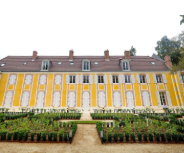
@NGnewsgeorgia. In France, a large-scale, years-long reconstruction of the Leville estate has been completed—the historic manor 30 kilometers from Paris that, after the Soviet occupation of 1921, became the main center of Georgian political emigration. Tbilisi is now presenting Leville as Georgia’s flagship cultural and educational hub in the very heart of Europe.
The authorities marked the completion of the work with particular fanfare. An imposing delegation arrived in France for the ceremony: Prime Minister Irakli Kobakhidze, Parliament Speaker Shalva Papuashvili, Minister of Culture Maia Bitadze, Economy Minister Mariam Kvrivishvili, Agriculture Minister Davit Songhulashvili, key lawmakers from the ruling party, diplomats, and Georgian musicians.
The estate covers about 4.5 hectares. Its architectural heritage—a two-story château in the Louis XIII style—has undergone a major transformation. A Museum of the History of the First Democratic Republic and Georgian-French Relations was opened there, and the office of Noe Zhordania, chairman of the government in exile, was recreated. A library, media library, archive, and conference hall have been established on the estate. Leville’s main educational “anchor” will be an academy intended for scholars, researchers, and students from Georgia and Europe.
The estate’s park has also acquired a national character. Among the centuries-old linden trees, they planted a vineyard with endemic grape varieties, buried a traditional qvevri, and built an oda—a traditional wooden house from western Georgia.
“The Leville estate is not just a museum. It has become a multifunctional cultural and educational center in the heart of Europe, fully open to our diaspora and to everyone interested in the history of Georgia,” Kobakhidze said.
Speaking at the ceremony, the prime minister said that the large-scale work had been completed “ahead of schedule.” However, the documentation says otherwise.
Initially, in 2016, €5 million was allocated from the budget for the work, with completion scheduled for 2026. In the end, the amount exceeded €7 million, while the French contractors received extensions several times. Thus, Leville became not only the main historic project but also one of the most expensive overseas projects funded by the Georgian budget.
One of the most dramatic chapters in the history of Georgian statehood is connected with the estate.
After the government of the First Democratic Republic left Georgia in 1921 and ended up in France, the émigrés began searching for a place where they could preserve not only the ability to live, but also the very idea of an independent Georgia. In 1922, they acquired a small estate not far from Paris that became at once a refuge, a farm, an archive, and the political center of the emigration. There, Georgians established a library and a printing press, kept documents, and worked in the garden and vineyard.
The main house still holds a priceless relic—the original Act of Independence of Georgia dated May 26, 1918. And key figures of the First Republic found their final resting place in the local cemetery.
Negotiations on transferring ownership of the estate to Georgia had been underway since 1991. In 2011, the French government officially announced its agreement to return the estate, and the legal transfer process was completed in 2016, when Tbilisi assumed responsibility for its restoration.
Add new comment