
“It was the best time for me”
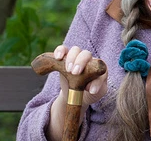
How a Belarusian woman moved her 81-year-old mother to Poland.
When, after 2020, Elena (name changed) decided to leave Belarus for Poland with her family, she never considered leaving her mother behind: they had lived together their entire lives. Elena noticed signs of dementia in the woman, but in Belarus she was never diagnosed. That happened only in Poland. Three years later, she died. Elena told MOST about the move, the diagnosis, her mother's life in a nursing home, and her loss.
Elena began suspecting that her mother had health problems while they were still in Belarus. The woman would repeat the same thing several times, forgetting what she had said and done. Once, she even mistook a container of plant treatment kept at the dacha for a bottle of milk.
— It wasn't the deepest stage yet, but she was already forgetting where home was. We had two similar houses next to each other, and sometimes Mom would go into the wrong one. After that incident, she was immediately hospitalized, in the ward where patients who had attempted suicide are usually kept. A psychiatrist spoke with her several times to determine whether she had done it intentionally or by accident.
But Yadviga was never officially diagnosed in Belarus. Neurologists performed an MRI and other tests, but they attributed the changes in her behavior to her age.
The family spent about two years preparing for the move. Elena wanted to obtain a Pole's Card based on her Polish roots. Yadviga is ethnically Polish, but, like many others, she had been recorded as Belarusian in Soviet documents. There was no direct proof of her Polish origin, so they had to collect documents from the Polish side, all the way down to her father's military ID.
When the family began applying for the Pole's Card, Yadviga was 81 years old.
— When the consul saw her—such a smartly dressed little dandelion, 81 years old, in a blouse and a white skirt—he didn't conduct the standard interview. He looked at her and said, “Let Mom sit here; I'll talk to you.”
About two or three months before the departure, Yadviga began to realize that the move was inevitable. According to Elena, she really did not want to go. But in the end, the family left for Poland together.
Demanded to be taken back at the Polish border
The journey to Poland was hard on the family—they traveled for about 30 hours in temperatures of 30 degrees.
— Somewhere near the border, in Brest, she was shouting that she wanted them to leave her there. We weren't taking any medication at the time, and it was very difficult. While she was sleeping, everything was fine; then she would demand to be taken back, Elena recalls.
The psychiatrist suggested drawing a clock face
Despite the difficult journey, adjusting to life in Poland went surprisingly well.
— The most important thing for her was having a church five minutes away on foot. We chose the apartment specifically with that in mind, so Mom wouldn't have to walk far. She attended services once or twice a day—that was her life.
It was then that the family finally found a psychiatrist in Poland who was able to make an accurate diagnosis—dementia.
— She drew a clock face: a circle in the middle, with all the numbers around it, jumbled up. When I saw it, I understood: that's it, it's over. At the same time, Mom still remembered her children's names and what year she was born. The conversation with the doctor lasted about fifty minutes, after which he said: your stage is moderate, but prepare yourself—it won't get better. He said, “We'll give you pills to slow the process down a little,” Elena recalls.
The woman is certain that if the illness had been recognized in time in Belarus and her mother had been referred to specialists, they would have had several more years: “the earlier you start treatment, the longer a person remains themselves.”
To keep track of her mother, Elena installed a parental-control feature on her phone.
— I knew where she was going and how she was getting there. A couple of times I ran after her around the neighborhood—fortunately, I worked remotely. I don't know what would have happened if I'd worked in an office, she says.
Simple household measures also made the adjustment easier, such as notes posted around the apartment during the first period after the move: on the front door, “don't go out alone”; in the kitchen and elsewhere, reminders of what was where.
— I think she cried only during the journey—about twelve hours in, when she realized that something was wrong. Mom is a very sociable person and quickly made new acquaintances in Poland.
Later, Elena found a companion for her mother. The Ukrainian woman came to see Yadviga a couple of times a week, and they went for walks and shopping together. According to Elena, the doctor also recommended the companion service as a way to provide additional socialization, since her life was largely limited to YouTube and church.
“One of the two of us would go crazy faster”
Over time, Elena began to realize that providing round-the-clock care was becoming unbearable.
— One of the two of us would go crazy faster. I felt that it would be me. My husband and daughter supported me, but providing care 24 hours a day, seven days a week was truly frightening. I was so tired that I didn’t even want to talk to anyone anymore, Elena admits.
Her elderly mother’s condition continued to deteriorate: she began having trouble finding her way outside familiar routes, suffered from incontinence, and spent sleepless nights putting on all the clothes from her wardrobe.
— At times, even listening to that rustling became frightening, when you realized that you were too scared to go in there and see what was happening, Elena says.
“The residents were such sweethearts, each in their own little world: they could put on makeup at night, pick up a handbag, and go to the store”
That was how the family came to the decision to place her mother in a care home. To do so, they needed to obtain a certificate from the family doctor confirming the diagnosis. Elena warns of one important detail: a person can be admitted to a care home only while they are still able to sign their consent themselves. If a person does not want to sign or is no longer able to, they will not be admitted to a care home—in that case, the family must go through the process of obtaining legal guardianship. And that is a lengthy process.
Jadwiga signed the consent documents. Elena rented a private room for her mother in the care home—she did not want to have her share a room with anyone else, so that her nighttime restlessness would not disturb the other residents. A month’s stay cost 5,000 zlotys. The price included meals and regular visits from a doctor and nurses.
— The girls who looked after her—from Ukraine and Poland—were so kind; I could never have imagined it. About 80% of the residents there were like my mother—such sweethearts, each in their own little world, who might, for example, put on makeup at night, pick up a handbag, and try to go to the store.
For Elena herself, the three months in the care home unexpectedly became a bright period in her life.
— It was probably the best time I had spent with her in the state she was in. I would visit on weekends, and we would talk. There was none of that pent-up anger caused by my own helplessness. The hour or hour and a half I spent with my mother was of an entirely different quality, Elena says.
The pills gave her a year and a half of a reasonably normal life
Jadwiga lived in the care home for three months. Then she died.
— She never even reached the bedridden stage. She was bedridden for only three days before she died—it happened very suddenly. The doctor explained that the course of the disease can vary: some people remain bedridden for years, while for others it ends abruptly.
Jadwiga was buried in Poland.
— No one calls here and drives you crazy, as they do in Belarus, where a person has barely died and ten funeral homes are already calling you, she says. — I found a funeral agency nearby myself and called them—they said, “No problem, just give us the address and we’ll take care of everything.”
The Polish government paid Elena a benefit toward the funeral and arrangements—about 4,000 zlotys at the time.
— Thank God for that doctor and those pills, which gave us another year and a half of a reasonably normal life—when a person can look after themselves and cook some porridge. In Belarus, where I worked in an office and we all left the house, we simply would not have had that time. In the end, everything turned out as it did. And thank God.
Add new comment